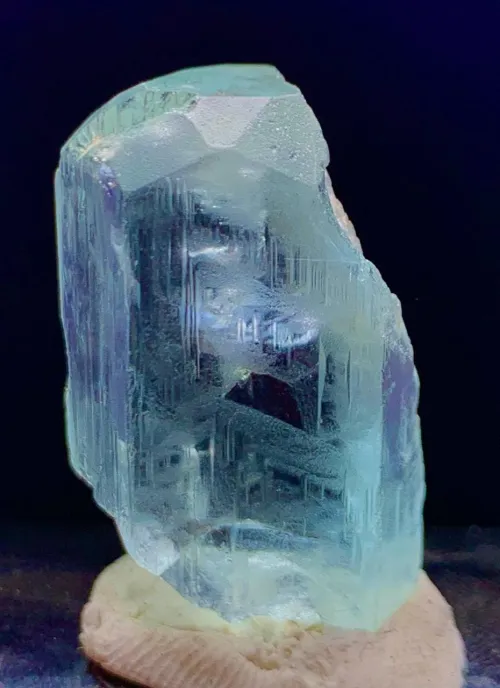
Many gemstone enthusiasts wonder why certain aquamarines display that perfect sea-blue while others appear washed out or green-tinged. You might hear conflicting explanations about color origins – from oceanic connections to mineral impurities – leaving you uncertain about what truly matters. This guide systematically explores key physical and optical properties, separating common assumptions from verifiable mineral science. By understanding eight essential relationships between chemistry, geology, and light behavior, you'll develop methods to assess blue quality beyond surface appearance and marketing descriptions.
People often assume aquamarine's color comes directly from water content since its name means "seawater." This intuitive connection leads many to judge stones by surface-level ocean-like appearance rather than structural science. Marketing descriptions further reinforce aquatic associations instead of explaining actual mineral properties.
In reality, color arises from how light travels through a complex crystalline structure containing metallic impurities. Selective absorption occurs when certain wavelengths get trapped within iron-containing molecular bonds. Technically speaking, divalent iron ions within the crystal lattice contribute significantly to the blue hue through electron transitions that filter out yellow and red wavelengths, leaving primarily green-blue tones visible.
When examining aquamarine, focus examination under natural daylight rather than showcase lighting. Notice whether blue remains consistent when rotating the stone – authentic color shouldn't radically shift with angle changes. Remember that naming connections to oceans are poetic, not mineralogical explanations.
A common question asks: "Why does some aquamarine look greenish?" This assumption that pure aquamarine should always be blue overlooks how trace elements interact within crystalline spaces. Color variations often happen when people mistake beryl-family differences, expecting uniform mineral behavior across specimens with divergent chemistry.
The clearer way to see it is: Small impurities create color centers within aluminum-silicate tetrahedral structures that host light manipulation. Secondary green hues may appear when trace amounts chromium exist alongside dominant iron. Crystal field transitions in ferrous ions dictate whether blue dominates or green surfaces in specific chemical configurations.
When comparing stones, ask jewelers about spectroscopic reports showing iron-chromium ratios that indicate blue-green balance. Notice structural channels along the C-axis – natural directional variations can create beautiful gradients that treatments artificially flatten.
Many observe how aquamarine appears brighter in certain lights, leading to assumptions that the gem "changes color." This misunderstanding about optical dynamics overlooks fixed absorption characteristics shaped by atomic arrangements.
Technically speaking, blue wavelengths are selectively transmitted due to specific absorption bands at 427 nm and 456 nm – these become signature spectral fingerprints. Refractive indices ranging from 1.574 to 1.580 optimize internal reflections, creating depth through repetitive light bouncing. Pleochroism displays varying blue intensities at different crystal orientations, meaning apparent brightness changes depend on viewing angle, not core color alteration.
Evaluate stones using multiple light sources: daylight reveals true color range while incandescent light showcases brilliance patterns. Notice whether color zoning follows natural crystalline geometry – precise parallel patterns suggest authenticity. Cutting geometry directly affects apparent color depth through light path manipulation, so compare similar cut styles.
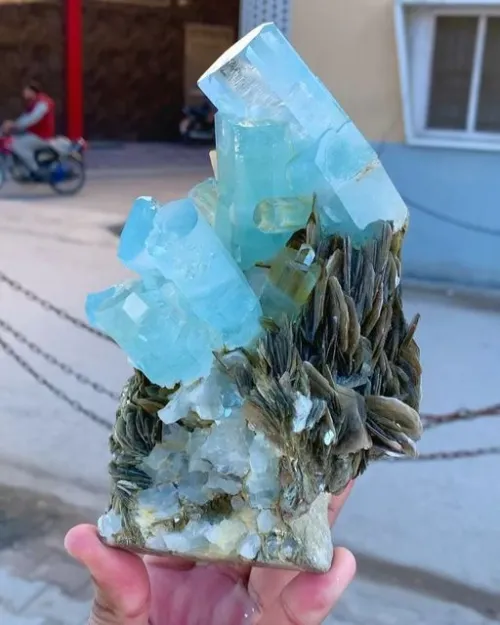
"Do all aquamarines form near oceans?" This assumption confuses geographic location with mineral formation processes. Such myths distract from how hydrothermal chemistry creates essential conditions for blue development regardless of proximity to water bodies.
Geological reality shows pegmatitic hydrothermal conditions enable iron incorporation necessary for blue saturation. Iron concentration and geological formation pressure correlate with resulting color depth. Temperature gradients during crystallization create structural variations that impact how light travels. Natural radiation exposure introduces minor color centers contributing to nuanced tones rarely replicated through treatments.
When researching provenance, prioritize formation environment documentation over geographic names. Specimens from mountainous regions far from oceans often show identical chemistry to coastal stones. Focus appraisal reports documenting crystal fluid inclusions that verify natural growth processes.
Many believe heat treatment "ruins" authenticity without knowing specific alteration thresholds. Uncertainty arises when vendors avoid disclosing enhancement methods, making subtle differences appear as natural variations to untrained eyes.
Practically speaking, thermal enhancement treatments can optimize hue by altering iron oxidation states – often shifting greenish tones toward purer blue. Identification requires recognizing telltale signs: natural stones exhibit subtle internal color zoning along natural growth axes while treated specimens may display uniform saturation throughout. Specific gravity measurements may detect density variations indicating treatments.
Request documentation using professional terminology like "thermal optimization" rather than vague "enhancement" claims. When possible, view stones before/after treatment to train your eye on saturation patterns. Natural specimens tend to show depth variations that appear less manufactured than fully optimized stones.
A common market confusion involves describing light-blue stones as "top quality" based solely on size or clarity. Without standardization, commercial terms like "sky blue" or "ocean blue" become subjective rather than mineralogical references.
Objective systems grade saturation through spectrometer readings showing how effectively iron filtering occurs at key wavelengths. Apparent color depth increases through light path manipulation during cutting – skilled artisans align facet patterns with crystal axes to maximize internal reflections. A hardness rating of 7.5–8 on the Mohs scale ensures surface stability during light transmission, though variations may subtly affect brilliance.
Compare stones using daylight equivalents rather than gem show cases. Learn to distinguish cut-manufactured intensity versus natural saturation – overly bright specimens without zoning patterns warrant further scrutiny. Industry grading reports from IGL or GIA provide measurable metrics rather than creative descriptors.
"Will my stone fade like blue topaz?" People sometimes conflate aquamarine with photosensitive gems despite their distinct mineral makeup. This confusion leads to unnecessary caution about everyday exposure.
Scientific observation shows long-term sun exposure typically causes negligible fading under normal conditions due to stable chemical bonds. Structural protection occurs naturally through robust aluminum-silicate tetrahedral frameworks. Cleaning with ultrasonic methods tends to be safe due to minimal fracture inclusions in aquamarine compared to other gems like emerald. Protective facet arrangements mitigate potential surface abrasions over prolonged use.
For significant pieces, periodic inspections help document any changes beyond normal expectations. Though extremely rare, exposure to intense heat sources may temporarily alter hue through ionization changes that typically reverse after cooling. Normal wear shouldn't cause noticeable color shifts in quality stones.
This section tackles regular inquiries that surface during discussions about aquamarine's behavior and properties.
Is aquamarine prone to color fading?
Unlike many blue gems, quality aquamarine typically maintains stable color due to its iron-based coloration. While extended extreme UV exposure may potentially cause subtle changes over decades, everyday sunlight or artificial lighting tends to pose minimal risk.
Can standard jewelry cleaning damage aquamarine?
Most professional cleaning methods remain safe for this material. With minimal fracture inclusions and good structural integrity, ultrasonic cleaning presents low risk unless significant existing damage exists. Protective settings still help prevent mechanical shocks regardless of stone durability.
What stands between observation and judgment? Practice pairing structural awareness with optical knowledge. Begin by cross-referencing iron-content indicators (documented saturation levels) with light behavior characteristics (directional color patterns). Next time you encounter blue variations in aquamarine, apply the pressure-saturation relationship principle before accepting "natural variation" explanations casually. Progress emerges through systematically checking: crystalline clarity over superficial brightness, natural zoning versus uniform color, and supporting documentation beyond verbal assurances. Consistent focus on these relationships develops more confident assessments than any single checklist.


$
